
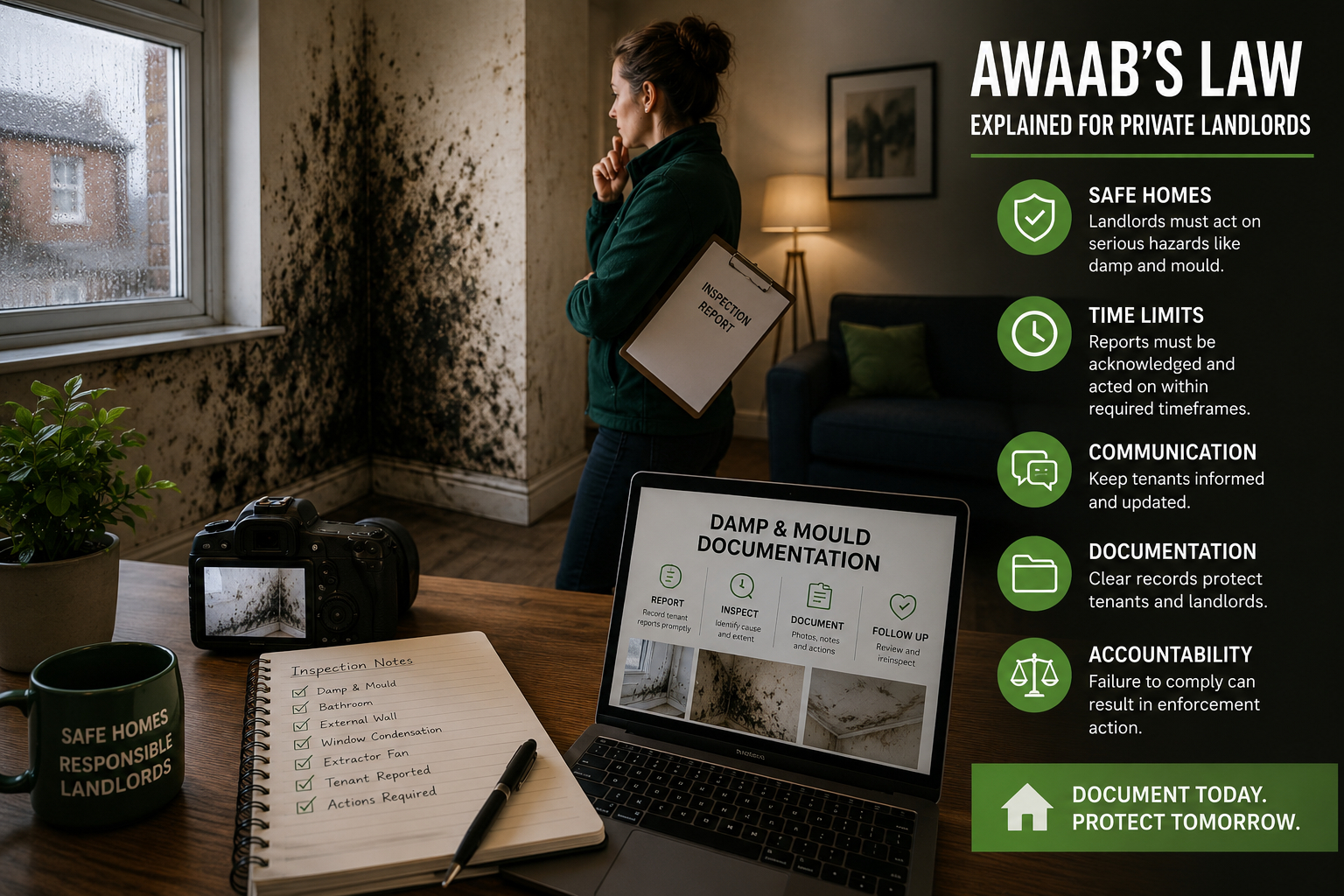
Awaab’s Law Explained for Private Landlords
Awaab’s Law has changed the conversation around damp, mould and unsafe housing. It began in social housing, but the Renters’ Rights Act will extend the principle into the private rented sector. For landlords, the message is clear: serious hazards must be taken seriously, documented properly and dealt with promptly.
What is Awaab’s Law?
Awaab’s Law was introduced after the death of Awaab Ishak, a two-year-old boy who died following exposure to mould in his home. The law is designed to make landlords respond more quickly to dangerous housing conditions.
The Housing Ombudsman explains that Awaab’s Law came into force for social landlords on 27 October 2025 and initially focuses on damp, mould and emergency hazards.
How does this affect private landlords?
GOV.UK’s Renters’ Rights Act guidance says Awaab’s Law will be extended to privately rented homes. The exact requirements for private landlords are being introduced in phases, but the direction is clear: reports of serious hazards need proper action, not delay.
What should landlords do now?
- Take damp and mould reports seriously from the first message.
- Inspect and document the issue promptly.
- Use photos to record the affected area and surrounding context.
- Keep written communication with tenants.
- Use contractors where investigation or repairs are needed.
- Arrange follow-up inspections after work is completed.
Why documentation matters
If a tenant says a landlord failed to act, records matter. A professional inspection report can show when the issue was inspected, what was found, what photos were taken and what follow-up was recommended.
How inventories fit in
A professional inventory records the condition of the property at move-in. If walls, windows, ventilation or bathrooms were already showing signs of staining, condensation or mould, this should be recorded clearly. If no issue existed at the start, that is also important evidence.
Practical warning signs to monitor
- Black mould around windows and external walls
- Peeling paint or wallpaper
- Musty smells
- Water staining on ceilings
- Blocked extractors or missing ventilation
- Tenant reports of respiratory symptoms or persistent damp
Final word
Awaab’s Law is about safety, accountability and evidence. Landlords who inspect, document and act early are better placed to protect tenants, avoid enforcement issues and keep properties in good condition.
Need inspection evidence for damp or mould concerns?
Our property reports help landlords document issues clearly and take practical next steps.