

How the Renters’ Rights Act Impacts Deposit Disputes
How the Renters’ Rights Act Impacts Deposit Disputes
The new Renters’ Rights Act changes how tenancies work in England — and it has a direct knock-on effect on deposit disputes. With stronger tenant rights and more focus on property standards, landlords and agents now need better evidence to justify deductions. This is where a professional, photographic inventory becomes essential.
What’s changed for deposits?
While deposit protection rules remain in place, the end of Section 21 ‘no-fault’ evictions and the shift to rolling (periodic) tenancies raise the bar for documentation. If a claim is made against a tenant’s deposit, adjudicators will expect clear, time-stamped proof of the property’s condition at the start and end of the tenancy — not just a few phone photos or a brief checklist.
Why inventories decide disputes
- Before the tenancy (Check-In): An independent inventory records cleanliness, condition and contents with dated photography, meter readings and keys.
- During the tenancy (Mid-Term): Optional inspections help track issues, plan maintenance and keep expectations clear.
- At the end (Check-Out): A detailed check-out report compares the final condition against check-in, highlighting changes beyond fair wear and tear.
When there’s a dispute, adjudicators look for consistency, clarity and neutrality. Reports produced by a third party carry more weight than self-written notes.
Common reasons landlords lose deposit claims
- No check-in report — Nothing to compare the check-out against.
- Vague wording — Terms like “messy” or “poor” without photos or specifics.
- No cleaning standard agreed — Leads to arguments about what’s “acceptable”.
- Missing invoices/quotes — Deductions must be realistic and evidenced.
Cleaning: the #1 cause of deductions
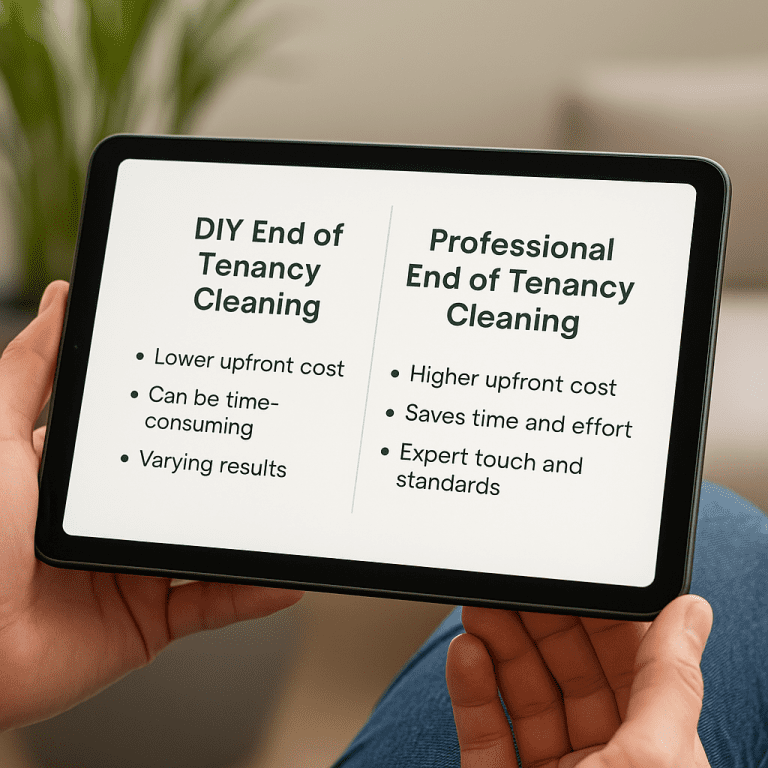
Most disputes are about cleaning. If the property was professionally cleaned at move-in but not at move-out, you’re on stronger ground for deductions. To avoid arguments, set expectations clearly and consider booking end of tenancy cleaning aligned with your inventory standards.
Wear & tear vs. damage
Wear & tear happens naturally (e.g., light scuffs, minor carpet flattening). Damage is avoidable (e.g., burns, heavy stains, broken fittings). Your inventory and check-out photos show the difference — the crucial proof for adjudicators.
Your dispute-proof checklist
- Book a professional check-in report with embedded photos and meter readings.
- Agree cleaning standards in writing and share them at the start.
- Consider a mid-term inspection (with photos) for longer stays.
- Use a neutral check-out report comparing like-for-like areas and items.
- Keep documentation together — reports, invoices, quotes and communications.
Technology that keeps you covered
We capture evidence on tablets, compile reports digitally and deliver them same-day where needed. That means crisp, dated photography, clear wording and a professional layout — built to stand up in a dispute.
Next steps
Protect your property and avoid the stress of drawn-out disputes. Use an independent, photographic inventory at the start and end of every tenancy, and align cleaning to the same standard. It’s the simplest way to stay fair, transparent and compliant under the new rules.
Need help? We provide inventory services, check-in & check-out reports, end of tenancy cleaning and EPCs across Surrey, Berkshire & Hampshire.
Want fewer disputes and faster deposit returns?
Book a professional, photographic inventory today — built to stand up in adjudication.
Contact Us




One Comment
Comments are closed.